Leadership is not a role. It’s a responsibility
Why John Adair has shaped my professional and civic life for over forty years – and why his thinking matters now.
2/1/20264 min read
I was eighteen when I was first introduced to John Adair.
I was a young Scout leader, learning in real time what it meant to be responsible for other people. Not in theory, but on cold campsites, in the church hall at the bottom of St Michael's Hill in Bristol, on long walks home after difficult conversations. Somewhere early on, I encountered Adair’s Action Centred Leadership model. I didn’t know then that it would quietly underpin almost everything I have done since.
I only know now that it has.
Across more than forty years of professional and civic life – youth work, education, charities, international roles, governance, and now public service – I can see how often I have returned, instinctively, to the same questions:
What is the task here – really?
What does this mean for the team, the organisation, the community?
And what does it mean for the individual people involved?
I have never experienced leadership as a purely positional act. It has always felt relational, contextual, and moral. Adair gave me a language – and a discipline – for that.
A model that travels with you
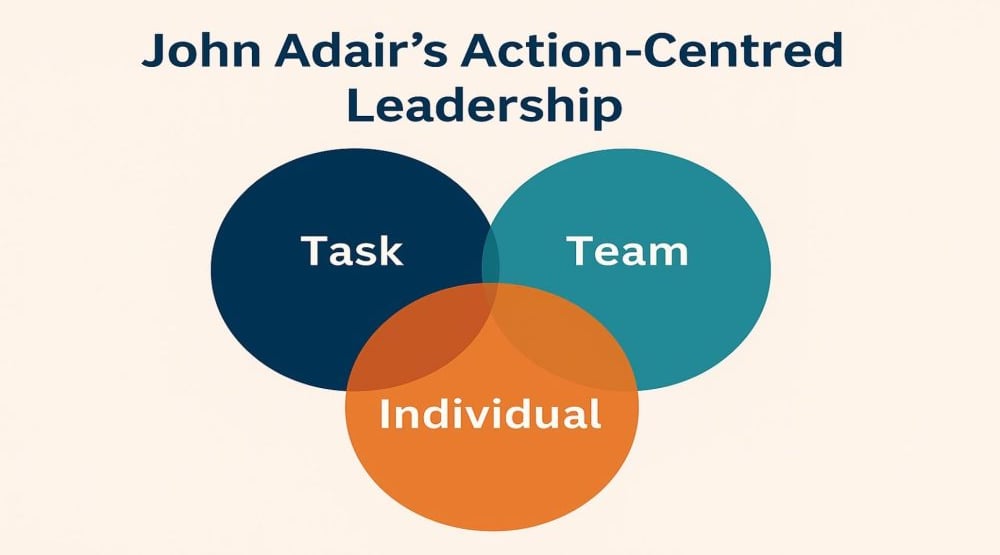
Adair’s great contribution was not complexity, but clarity. Leadership, he argued, is the constant balancing of three responsibilities:
The task – the work that must be done
The team – the collective capacity that makes it possible
The individual – the human being, with dignity, potential and limits
Ignore any one of these, and leadership weakens.
I have seen this play out repeatedly. In charities that hit targets while burning out their people. In boards that care deeply about individuals but lose strategic grip. In teams that are warm and cohesive but drift without purpose.
The model is deceptively simple – and unforgiving if ignored.
What I realise now is how much it has shaped my leadership across very different contexts. As Chief Executive of a national charity, as Chair of trustees, as a civic leader, and in my current role as High Sheriff. The scale changes. The responsibility does not.
What this means for civic leadership
Over the past year, serving in a civil role has sharpened something for me.
We are not short of people with titles, platforms or authority. But we are struggling with leadership that sees beyond organisational, sectoral or personal boundaries. Too often, responsibility is interpreted narrowly – stopping at the edge of a remit, a funding line, or a reputational risk.
The consequences are not contained.
Fragmented leadership produces fragmented outcomes. Institutions weaken. Trust erodes. Communities feel unseen. Public discourse becomes brittle and performative.
Seen through an Adair lens, this feels like a profound imbalance. We have become overly task-focused as a society – delivery, metrics, short-term outcomes – while underinvesting in teams (our institutions, communities, shared civic fabric) and individuals (capability, confidence, belonging, especially among the young).
That imbalance shows up everywhere I look: in youth services under strain, in the voluntary sector stretched thin, in public systems struggling to hold complexity with humanity.
Why this feels urgent now
In my professional life, I spend a great deal of time with people who carry serious responsibility – leaders in charities, education, policing, business, local government, and community organisations. What I hear most often is not a desire for louder leadership, but for better leadership.
Leadership that is thoughtful rather than performative.
...That strengthens trust rather than simply delivering outputs.
...That leaves institutions healthier than it found them.
This has become even clearer through my civic work this year. When you step slightly outside organisational hierarchies, you see how interconnected everything really is – and how limiting narrow leadership can be.
Adair’s model keeps returning to me because it insists that leadership is never just about getting things done. It is about how things are done, with whom, and at what human cost.
Leadership as stewardship
I increasingly describe this as dynamic stewardship.
We inherit organisations, systems, communities – and collectively, a country. Leadership is not about preserving them unchanged, nor about exploiting them for short-term gain, but about passing them on fit for the next generation.
That demands judgement. Restraint. Imagination. Humility.
It also demands that leaders accept responsibility for impacts beyond their immediate line of sight – including on people they will never meet and futures they will not personally inhabit.
This is where Adair’s thinking feels so contemporary. His model scales effortlessly from a small team to a national conversation. Task. Team. Individual. Always in balance. Always human.
Why leadership is now everyone’s job
I do not believe leadership is elitist or confined to those with formal authority. It exists wherever someone chooses to take responsibility beyond themselves.
In communities.
In voluntary organisations.
In boardrooms and classrooms.
In everyday decisions about voice, care and accountability.
In a complex, pressured society, leadership cannot be outsourced upwards and then criticised from a distance. The future is too important for that. Leadership now requires participation – a shared sense of responsibility for the whole, not just our part.
That is the thread that runs from my eighteen-year-old self to where I am now. I may not have named it at the time, but I was learning that leadership is less about status and more about service. Less about certainty and more about balance.
John Adair gave me a framework that has lasted because it tells the truth about leadership: it is human work, done among humans, with consequences that ripple far beyond the moment.
And that is precisely why, now more than ever, leadership is not just someone else’s job. It is all of ours.
Lilywood Advisory Services Ltd
Registered in England and Wales
Company number: 16907039
Registered office: Lilywood House, North Lane, Weston on the Green, Bicester OX25 3RG
hello@lilywood.net
© 2026. All rights reserved.
Privacy notice | Cookie policy
We respect your privacy and collect only what we need.